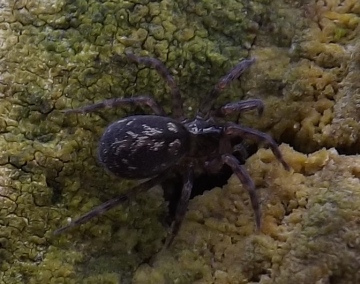
Summary for Sitticus distinguendus (Araneae)

previous species | next species

National Distribution

Sitticus distinguendus female
Name: Sitticus distinguendus
Authority: (Simon, 1868)
Order: Arachnida: Araneae
Family: Salticidae
BAP status: UKBAP

Records: 18
First Record: 2003
Latest Record: 2010

1992-on hectads: 2
Pre-1992 hectads: 0
Total hectads: 2

Explore Regional Distribution

Please log on and add a note on this species


About this species

Distribution
Known from two post-industrial sites within a few kilometres of each other on both sides of the Thames in South Essex and north Kent. Checklists available for western and central European countries indicate that S. distinguendus is evidently widespread, listed for France, Netherlands, Belgium, Sweden, Norway, Germany, Switzerland, Austria, Czech Republic, Hungary, Romania and Poland. However although Bonte et al. (2003) record the species as fairly common at the sites sampled at Boulonnais in northern France, they did not record it from sites sampled in Belgium and the Netherlands and also note that grey dunes are now heavily fragmented and patchily distributed within a matrix of dense dune vegetation. S. distinguendus is listed as Endangered in the Czech Republic (Buchar & Růžička, 2002) and in Flanders (Instituut voor Natuurbehoud, 2005). It has a Proposed Red List status of Endangered and Declining in Norway, as Vulnerable in Poland (Zabka, 1997), and there is only one 10km dot for the species in the Spiders of Serbia. It is also regarded as one of the most interesting species from Antwerp (Vanuytven, 1997).

Habitat and ecology
At the South Essex site the very localised habitat is dry sparsely vegetated ground close to seasonally wet areas on a substrate of fine almost sand-like pulverised fuel ash (PFA) and stony clinker that has a distinctly saline character. Here the spider was present in some numbers within a very small localised area. In the area immediately adjacent to where the spider has been found salt can often be seen encrusted on the surface and plants such as glasswort Salicornia grow. At the Kent site the very sparse, open grassland in which the specimen was collected has developed on a substrate of cement factory flue-ash. In terms of soil texture and possibly micro-climate this is likely to be rather similar to the PFA habitat in South Essex. The character of the habitat where the spider has been found in Britain appears to have distinct ecological similarities to most of its recorded habitats in Europe, for example grey dune vegetation has high affinities with heathland and chalk grassland vegetation. In Europe the spider has also been recorded from steppes, salt marshes, sloping shrub-stony steppes, screes and cobble-gramineous stands, a bird cherry stand, stony river banks and taiga edges, larch forests and mountain steppe-semidesert, cliffs and screes and sandy places covered with sparse vegetation.

Status
UK Biodiversity Action Plan priority species. A spider with a very restricted distribution and a very small population. The two sites from which it has been recorded in the Thames corridor are under imminent threat for building development. A large proportion of the habitat at the Essex site, which is thought to hold over 90% of the British population, is scheduled for development.

Threats
Although only first collected in Britain in 2003, the species is unlikely to have been overlooked, and known and potential sites are highly threatened by development in the near future.

Management and conservation
Ensure the two sites where it occurs are protected from development.

Text based on Dawson, I.K., Harvey, P.R., Merrett, P. & Russell-Smith, A.R. (in prep.).  References

Adult Season

Adult Season Data (based on 14 records with adult season information)


Habitats

background methodology

Broad Habitat Data (based on 12 records with habitat information)

no subhabitat data available

Structural Habitat Data (based on 14 records with structural habitat information)

Habitat Detail and Method (based on 5 records with habitat detail and method information)

Recorded management for locations with Sitticus distinguendus

Recorded substrate and hydrology for locations with Sitticus distinguendus

Images

Sitticus distinguendus female
Sitticus distinguendus male
please log on and upload a new image for this species

See also A-Z Species Index - A-Z Picture Index - previous species | next species